Comparative study of cultures / Hofstede dimensions

A very brief blog, to make you (and me!) aware of the work of father and son team, Geert (and the younger Gert Van) Hofstede, around the comparative study of cultures. They have a downloadable file of “matrix of dimension scores” plus other papers, books and material: http://www.geerthofstede.nl/research–vsm.aspx

As ‘culture’ often comes up in the discussion of workplaces around the world, I thought this would be useful to share.

And thankyou to Maarten Kas ( http://www.linkedin.com/in/maartenkas ) for sharing this on the Linkedin Group “The European Centre for Facility Management”. It followed a question asked by Peter de Winter, Snr Programme Director for Workplace Innovation at Philips ( http://www.linkedin.com/pub/peter-de-winter/5/492/476 )

Peter asked:

Who has experience with including the cultural aspect in global office design? We apply a ‘one size fits all’ approach for our international and country HQ’s. Works quite well. Ideas for improvement?

‘OJ’ Careers & Jobs (#1 ; 3rd Feb 2012)

We started a new Linkedin Group on 24th January, called “Careers & Jobs (Open) CRE & Facilities Management”. The link is here: http://www.linkedin.com/groups?about=&gid=4269106

The Group has just over 1,600 members so far, and is growing quickly; see Group Stats here: http://www.linkedin.com/groups?groupDashboard=&gid=4269106

This is an entirely independent and ‘Open Group’ – i.e., anyone may join, and anyone may view discussions from within the Group or from an internet search.

As it says in the Group Profile, it is:

“For all careers discussions, and any job postings by organisations direct or via recruitment consultants for Corporate Real Estate (CRE), Facilities Management and Workplace/Change management”

Recruiters & Head-hunters

This group is independent, so we hope that any and all recruitment and head-hunting firms will start to use the group, and post vacancies to the ‘Jobs’ section. They (and anyone else) are also welcome to advertise their services on the “Discussions” section.

These people posted Jobs discussions this week (I will expand this list over the next few weeks, into a global list of recruiters, and save it on my shared ‘Box’ folder: https://www.box.net/shared/bxrprfdfr7 ). For now, here is this weeks list, in the order in which they posted:

John Kreis: http://www.linkedin.com/in/johnkreiss , Boston, MA, United States

John Bruno: http://www.linkedin.com/pub/john-bruno/16/402/7a6 , LA, CA, United States

Brittany Finnell: http://www.linkedin.com/pub/brittany-finnell/8/602/643 , Dallas, TX, United States

Keely Marlin: http://www.linkedin.com/in/keelymarlin , Denver, CO, United States

Nikki Dallas: http://www.linkedin.com/in/nikkidallas , London, UK

Cassie Rayner: http://www.linkedin.com/in/cassierayner , Leeds, UK

Jo Caughey: http://www.linkedin.com/in/jcaughey , Birmingham, UK

Ben Gregg: http://www.linkedin.com/pub/ben-gregg-0415919590/6/782/a11 , Sydney, Australia

Simon Knowles: http://www.linkedin.com/pub/simon-knowles/1/bb6/a8 , Exeter, UK

Chris Manning: http://www.linkedin.com/in/cjmanning , London, UK

Rebecca Worley: http://www.linkedin.com/in/rebeccaworley , Co. Durham, UK

Simon Aspinall: http://www.linkedin.com/in/simonaspinallcatch22 , Leeds, UK

Top Recruiter this week

My “referee’s decision” is final 🙂 This goes to Nikki Dallas, mentioned above, who posted 7 jobs this week..thanks Nikki.

So I’m giving Nikki a little ‘plug’ for helping to get our new Linkedin group off to a good start. If you want to know more about Nikki’s firm in London, see the website here: http://www.talentfm.co.uk/. I also know that Nikki deals with global appointments, so if you are not in the UK, do not let that stop you connecting!

Top jobs this week

Again, just a personal choice…

Simon Aspinall advertised this Group Facilities Manager role in West Yorkshire: http://preview.alturl.com/6fg64

There were many others posted this week, from China, to several in Europe (Finland, Germany, UK, France) and the USA. Hopefully we will go wider still in week 2….!

Top Discussions:

Katya from New Zealand ( http://www.linkedin.com/pub/katya-van-den-nieuwenhuysen/13/395/403 ) tops the “Discussions” list this week with her question, “What are five things that attract you to a job position?”; this has had 10 responses, last time I looked, and will continue I’m sure. Thanks Katya.

Working @

I’m also trying to launch a new series, called “Working @”….and so I very much thank Ali Green (  http://www.linkedin.com/pub/ali-green/a/145/901 ) from Louisville, Kentucky, for her inside view of working at Amazon – “a personal view as a Facility Manager” http://lnkd.in/gj5RTt

That’s all folks for this week, but subscribe to this blog and receive the update every Friday….

Have a great weekend, and if you are job-hunting, good luck,

Paul Carder (paul.carder@occupiersjournal.com)

“Occupiers Journal – Global Network” (Linkedin Group: 600+ end user members)

Hi all,

I hope that your 2012 is getting off to a great start (and I hope that it continues that way, of course!). As we start the year, I thought that it would be useful to look at the composition of our global Linkedin Group, which you can find at the following link: http://www.linkedin.com/groups?about=&gid=2275314

The group is for end-users only (sorry if that excludes you, but that was the format that was asked for, as there are very few groups – real or virtual – that cater solely for client-side corporate managers).

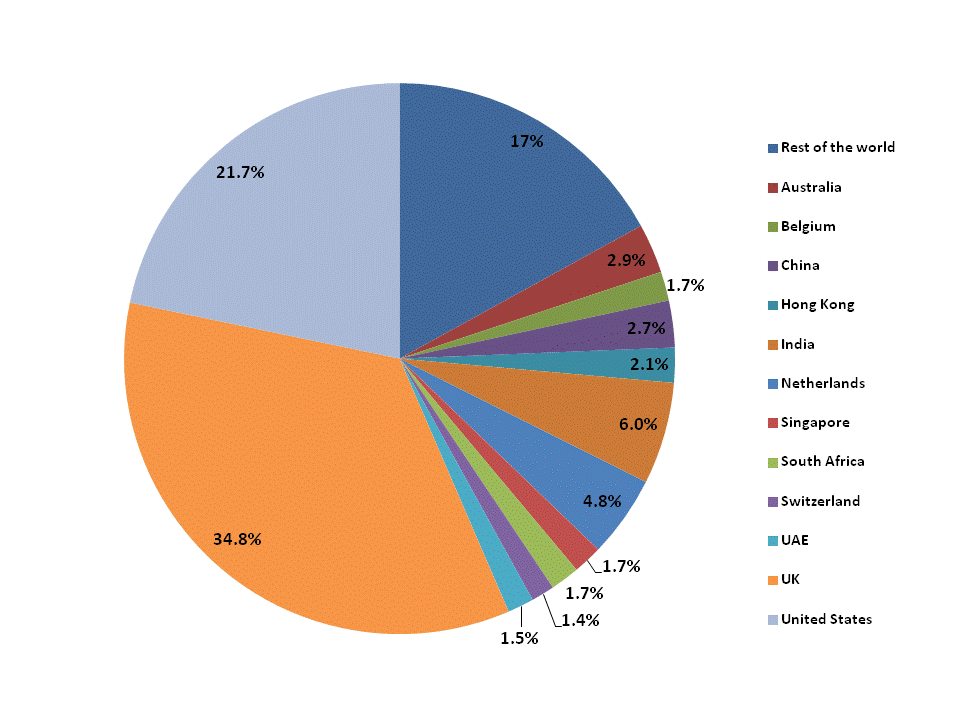
Please pass the URL above to your occupier colleagues and friends. The Linkedin Group has now topped 600 members, and has a very international spread, as seen below. But we need more members in mainland Europe (almost 35% are UK) and across the Middle East, Africa, Asia and Latin America.

Maslow’s hierarchy and the festive spirit!

As we approach the end of any year we all tend to look back, and take stock of where we are, and perhaps what we have achieved. It has been the first experience of a ‘really tough year’ for a lot of people in the north-west hemisphere, and sadly 2012 is not looking much rosier. I say north-west because to many millions of other people in parts of South America, Africa, rural India and China, our worst recession for 100 years is nothing of course. In fact, so much so that I thought of Maslow’s hierarchy of needs (below). How many of us have recently dropped back from the top two levels, to focus more on basic needs? Whether you are reading this as a business person, an advisor, a facilities manager, or some other role, there is something in this model for all to ponder.

At this time of year, I sincerely wish you all the very best, and hope that whatever part of the world you are living in, you are at least at the top of Maslow’s ‘social needs’ level as above. The higher the better, of course!

But, do keep your eyes and ears open, and extend your festive spirit to others who may have dropped back a level or two this year…..

If you are a Facilities Director/Manager, take a moment to think about the many people working from the buildings that you manage. You and your teams may be in a better position to see? Whilst the finance department is working to try to keep you in the black, and the front-line business units are schmoozing their clients to oil the wheels of commerce, how many other people are worried right now. Or worse. Ask your teams – people out there on the floors – to keep their eyes & ears open.

Looking more positively, on a lighter note, we are responsible for the accommodation and facilities services for many thousands of people across our organisations. Whilst food, drink, heating (or cooling!) and safety may be taken as a given (but can always be improved upon), can we improve on people’s social and esteem needs through the environments that we deliver? The answer is yes – but we must always remember the human element of working environments! Bland, corporate, clear-desk ‘hot-desk’ areas have a place – but hopefully a small place – in the modern, colourful, vibrant workplace. You want people to feel good about working in your buildings. Don’t let health & safety stop you putting up your festive decorations 🙂

We wish you a happy and peaceful Christmas (or whatever you do at this time of year), and best wishes for the New Year. We have some exciting plans for our FM “GRID” programme, and will be back in early January to tell you more!

kind regards, Paul

Founder/Managing Director, Occupiers Journal Limited

paul.carder@occupiersjournal.com / Skype: paul.carder.uk

Hong Kong  –  London  –  San Francisco

The OPN’s 31st workshop will be at PwC More London, on Tues 7 Feb 2012

By Paul Bartlett, Chairman, Office Productivity Network

The Office Productivity Network’s next event will be on Tuesday, 7 February 2012, at PwC’s More London new offices which display “understated excellence”. This will be the 31st OPN productivity best practice Workshop, all of which have shown exemplar workspaces which are delivering productive environments for occupants. Previous workshops have been at Unilever, KPMG, Southwark Council, AAT, GlaxoSmithKline, Herman Miller, Eversheds, Reuters, Johnson Controls, and MOD.

As part of PwC’s two centre location strategy and accommodating just over half of their 10,000 London workforce, 7 More London offered a unique opportunity for PwC to create a workplace that would reflect the values and ambitions of the firm. The objectives of the project included providing a flexible workplace to meet business needs now and for the long term. About 20% growth can be accommodated without physical change as working patterns evolve and people choose to use spaces differently. 7 More London provides:

• 460,000ft2 across 13 floors.

• Capacity for 6,000 heads in 4,000 workspaces at an overall sharing ratio of 1.5:1

• A further 690 workspaces in collaborative settings across the practice floors.

• 112 client facing meeting rooms with 22 dedicated videoconference facilities.

When arriving, visitors and staff can physically see how PwC does business. Exceptional occupier service is facilitated with spaces that work for individuals, groups, when working collaboratively in teams or with clients. There is 100% hotelling for everyone, with high standards of services (including quality refreshment hubs and floor concierges), a choice of workspaces, central secure client filing and, most importantly, continuous engagement with the various business units delivers maximum space utilisation. Sustainability was a key aim; despite its conventional corporate appearance, 7 More London is the first building in the capital to have been awarded a BREEAM Outstanding rating.

The event will include presentations on the property strategy for London, design, change management, POE and the occupier viewpoint. Delegates will have an extensive tour of the building. Places will be limited to 40, so if you wish to see at first hand how innovation can deliver cost efficient sustainable performance enhancement, contact Paul Bartlett, the OPN Chairman, for more details as soon as possible on paulbartlett@sbssol.co.uk or 01379 678899

Paul Bartlett, Chairman, Office Productivity Network

The Resilient Workplace

By Judith Heerwagen and Michael F. Bloom

In systems biology, resiliency is the capacity of a system and its inhabitants to bounce back from disruptive change, to cope with adversity without losing essential functionality and identity. The result is a more adaptive state with a greater capacity for effective re-organization. At the U.S. General Services Administration (GSA), we have been implementing strategies to make the GSA’s vast number of workplaces more resilient and, thus, sustainable.

The GSA’s Office of Federal High-Performance Green Buildings is the GSA’s green building center of excellence. As the federal government’s high-performance building thought leader and catalyst, the office strategically facilitates the adoption of integrated sustainable practices, technologies, and behaviors to accelerate achievement of a zero environmental footprint. GSA oversees 37.02 million square feet of office space in 9,624 buildings owned or leased by the federal government; 12,536 federal employees work in these buildings. Thus, the lessons from GSA’s federal building stock can be applied to many workplaces, large and small, in many contexts.

The federal building “system” today is much like a biological system facing disruptive change. The need to achieve aggressive environmental, financial, and operational goals and to reduce the federal spatial footprint, while maintaining the health and productivity of the workforce, is creating strong pressures to change. Can the built environment—and specifically the workplace—respond to disturbances and stresses with resiliency? Can we intentionally develop the capacity to adapt and cope by drawing on lessons from the natural world?

It is possible, but it will take unprecedented integration across boundaries, drawing on the knowledge and skills from disciplines that do not normally work collaboratively. Designers, technologists, policy makers, building operators, organizational and behavioral scientists—all have parts of the knowledge required to build a new way of thinking about work and workplace.

Unlike other organisms, humans have the potential to anticipate, create, evaluate, and change based on feedback and evidence. A resilient workplace requires a shift in the way we think about, use, and value space and highlights the need to establish feedback loops in order to adapt to and replicate what works. It also requires a shift to a more science-based understanding of the nuances of human behavior.  Ultimately, the main source of resiliency is people. Thus, we need to shape the workplace and its support system to provide the experiences that promote the human capacity to be creative—both individual and organizational—in the face of challenges both external and internal.

We define the resilient workplace as a system of interlinking components, none of which alone will generate resiliency. But in combination, they create synergies and mutual reinforcements that will drive the co-evolution of behavior and place toward resiliency.

The components include:

• A new way of thinking: Consideration of the workplace as an integrated whole, attuned to the relationships among space, management, work behaviors, policy, furnishings, technology, operations and communication practices. Today, most of these capabilities are in boxes and organization charts, each with its own perspective, rules, and ways of thinking.  Removing the barriers created by boxed thinking may be the most difficult challenge to implementing the resilient workplace. But as people learn to work collaboratively, the desire to engage others in thinking and planning will occur readily if it is nurtured.

• An evolution away from individually owned space: If work is not where you are, but what you do, why continue to assign individuals permanent space that remains vacant 60 to 70 percent of the time? This is a prime example of a non-adaptive workplace:  people for more than a decade have been characterized by mobility at work—whether just moving from meeting to meeting, or more broadly in multiple cities. Exchanging static, individual assigned space for the appropriate blend of support spaces that fit how work is accomplished broadens access to space that supports agency mission and releases resources that are unnecessary or wasteful. Assigned workstations may soon be to workplaces, as the vestigial appendix is to the human anatomy—present and taking up space but without performing a useful function.

• An evolution toward dispersed functionality: To be truly effective, the physical workplace should be just one node in a multiplicity of spaces that support connection among people across time and space boundaries. Organizations in which dispersed work teams become routine and the norm will be more effective in carrying out their missions even when disruptive events occur. Having the right kit of tools and technologies to work effectively as a team from multiple sites is a critical component of dispersed functionality.

• An investment in social capital: the workplace exists to support the people who work there, an employer’s most valuable resource. To survive, the workplace should service a niche and provide value that isn’t fulfilled elsewhere.  We believe that real value is supporting the synergies that drive effective teams. Face-to-face interaction is important for enculturation, socialization, creative problem solving, negotiation, and setting strategic direction.  But maintaining relationships in between face-to-face meetings can be readily supported from multiple locations, as can quiet, focused work.

An evidence based process: one that uses performance results as a basis for design, operations, technologies, furniture, and equipment purchases, as well as policy making over the life cycle of the workplace. By evidence, we mean not just objective data on factors such as space utilization, but also the tacit knowledge that develops through experience to become “know how.”

Elements of the resilient workplace

Taken alone, the elements that support the resilient workplace are not especially novel. Their transformative power comes through their combination. Here, we outline the key elements of the resilient workplace.
Space: Invest in space as social capital with focus on the different ways people work, focusing on collaboration, co-creating, and learning. Plan space by attending to best practices in indoor environmental quality, ergonomics, comfort, worker performance, operating performance, and technology supports. Space is no longer owned by individuals or linked to status; it may be shared with other organizations.
Furnishings: Furnishings are varied, flexible, and interchangeable—like a stage set that can be reconfigured easily. Ergonomics and comfort are critical, with an emphasis on work surfaces, including collaborative white boards. Increase reliance on consolidated storage of files and documents and ready access to shared electronic files.
Technology: Wireless, cloud-based, pervasive mobile tools (laptops, smart phones, tablets, etc.) are embedded into work practices with comprehensive technical support. Deploy technology to aid understanding, relationship development, information visualization, role playing, scenario development, and other practices that enable people to see in new ways. Technology supports both face-to-face and dispersed collaboration.
Management Strategy: Manage to performance rather than presence; create opportunities for cross group rather than stove-piped work and reward it when it occurs.
Work Behavior: Empower people to work wherever they work best; work is not where you are but what you do. Emphasize collaboration to achieve results and develop practices that work.
Policy: Co-create policy with workforce; policy becomes an accessible, living document that changes with new evidence to reflect
best practices.
Sustainability: The touchstone for all aspects of work, office design, renovation, and operations is sustainability, including life-cycle financial sustainability.
Operations: Building tenants are actively engaged in the impact of their behavior on how facilities function. Policies and programs to actively support behavioral change are common practices. Web-based discussions share how individual behavior affects building performance and how building performance impacts tenant health and productivity.
Communication: Communication is multi-modal and ubiquitous through asynchronous meetings, social media, chat, Webinars, and collaborative creation in the cloud.

A resilient workplace will succeed only where these characteristics intersect, and will thrive only when people are empowered and supported to work in new ways. Many of these elements are currently in place in public and private sector offices and telework experiments. But rarely have the elements been integrated in a systems perspective across the workplace life cycle.

Judith Heerwagen is an environmental psychologist specializing in the human factors of sustainability. She is a sustainability program expert at the GSA’s Office of Federal High-Performance Green Buildings, where she focuses on integrating research into policy making and on the relationship between building social and physical systems. She is co-editor of the book Biophilic Design: The Theory, Science and Practice of Bringing Buildings to Life (Wiley, 2008).
Michael F. Bloom is a sustainability and green program advisor with the GSA’s Office of Federal High-Performance Green Buildings. He is a workplace strategist and project lead for GSA’s new Sustainable Facilities Tool,
www.sftool.gov.

2011 IFMA Workplace Conference – Madrid

by Juan Luis de la Peña of 3G Office, Madrid (http://www.3g-office.com/inicio.html)

2011 IFMA Workplace Conference was held on 26-27th October kindly hosted by ENDESA in Madrid. All attendants (near 100 people) agree that it’s been an excellent conference with outstanding speakers and presentations as well as keynotes, moderators and round tables (plus a great catering!) where we all learned and shared real experiences, figures and trends regarding today’s ways of working and workplace solutions from several countries and business sectors.

Moderators:

Francisco Vázquez. President of 3G Office Group and Director of International Relations of IFMA Spain.

Leopoldo Alandete. Managing Director, LA & Asociados.

Xavier Llobera. General Manager, Microsoft Innovation Centre for Productivity Center.

All of them, Partners of the Workplace Innovation Group, played a great role in the conference, not only introducing the speakers but also questioning them and sharing their experiences and points of view regarding key matters in an open and frank way.

Conferences:

Introduction to Social Dynamics (by Francisco Vázquez)

Francisco made a clear introduction to how social dynamics are changing – dynamics that are mainly driven by technology, and new generations of people which are demanding new ways of working that suit their needs, and how companies are consequently adapting their workplaces to be flexible.

Agile Working in the UK (by Andrew Mawson, Managing Director, Advanced Workplace Associates Ltd)

Andrew introduced us to UK workplace trends, where there is some of the most expensive Real Estate in the world, and where most organizations are under pressure to reduce costs, but increase productivity. “Agile Working”, which is a dynamic way of working that frees people to work where and when it is appropriate for them and their organizations, pops up as solution. What is needed to support agile working are new layouts of office schemes with no owned spaces and overlapped areas with central or anchor points where groups gather around. He showed the today’s workplace situation by sector, from traditional (Legal, Retail) to mature (Telecoms, ITs). He pointed out that the change to agile working needs not only change management but “change maintenance” thereafter and that leadership from the directors of the business is the essential element.

Measuring the Value of Virtual Working (by Philippe Jimenez, Managing Director, Regus)

Philippe talked about a Regus research study based in big companies regarding measurement the benefits of the agility@work, a mix of real estate, commute, sustainability, technology, people and culture. The survey was done from three points of view: Virtual, AdVantages and Value, and showed results such as 63 % people still go to the office at least 4 days a week, 59% people takes more than 41 minutes to reach the office and the same to return home but only 12% want to work from home, and that 55% of the workplaces are not used. He also introduced the BYOC (Buy your own computer) model and the trend towards BYOW (Buy your own workplace).

Microsoft Milan (by Fernando Carneros, Real Estate & Facility Manager Microsoft Spain)

Fernando presented how Microsoft has evolved from “Bill’s Office” to a mobile workplace, by means of continuous research and, of course, technology. Before, team and individual settings were segregated and undifferentiated (highly hierarchical), today, a variety of team and individual settings mixed in clusters, with technology driving a multidimensional approach. He also introduced us to Microsoft Milan Innovation Campus (see YouTube) where new ways of work are continuously implemented.

Best Practices in the Financial Sector in London (by William Poole-Wilson, Director Pringle Brandon LLP)

William introduced his company and experience in the financial sector. He pointed out several general questions: Is London going to survive? What will be the landscape now? What does this mean for refurbishing? Numbers don’t stack up? Where is the money? Where is the space? And others more specifics: How can current available space be utilized for trading floors now and in the future? He went through several great examples of financial offices to answer the questions (case studies: Barclays, Macquarie) and showed the results of a survey conducted in trading floors users (for example they need faster communications and prefer clusters configuration of the space).

Importance of Measuring Workplace Spaces (by Carmen Ramos, Managing Director, Fama Systems)

Carmen, fromSpain, focused on the importance that new technology has in managing workplace spaces and the value of Computer Aided Facility Management (CAFM) software as a tool of measuring spaces and knowing exactly what there is in a building and so making easier to book and change spaces as well as move people when needed.

Measuring the activities in the workplace (by Germain Verbeemen, CEO, Wicely)

Germain, fromBelgium, started showing the evolution from “old” offices, passing by shared offices, to Activity Based Offices. He questioned how to conceive and manage Activity Based Offices. The answer is to measure occupancy and activities in an detailed manner with the right methodology and technology get trustworthy results that can be translated in “Activity Blocks” spaces that fulfill the needs of the people which are tuning in a “Generic Office Concept”. He concluded that an office must support effectiveness, flexibility, efficiency and attractiveness.

Measuring Productivity and Performance (by Tim Oldman, Founder and Managing Director, Leesman)

Tim gave a detailed presentation of what they name the Leesman Index by which they measure workplace effectiveness, the capability of workplace to support the productive activities of those it accommodates. He showed very interesting results from a study based on 5274 respondents, 22 surveys, 19 clients, 51 properties, c. 85,000 sq m and with a 70% response rate. He finally recommended that every company should ask themselves the following questions: what makes a workplace productive? What makes it unproductive? Where is it failing the occupiers? What interventions are required? How can it be bettered?

The office Code Project (by Catherine Gall, Director WorkSpace Futures Research, Steelcase)

Catherine presented a Steelcase Workspace Futures Study to know what the relationship between national culture and workplace design is. The study was based in 5 dimensions of culture: Power distance, Individualism, Masculinity, Uncertainty avoidance and Long-term orientation. She showed how the result of the study gives different “Office Codes” for each country.

Understanding Cultural Issues (by Marie Puybaraud, Director of Global Workplace Innovation, Johnson Controls)

From the point of view of the “Multi-generations @ Work” Marie introduced which are the workplace characteristics by generation (Veterans, Baby boomers, Generation X, Generation Y) and showed the very interesting, and sometimes surprising, results of a survey to answer the question of how important the workplace is in attracting, recruiting and retaining multi generations of workers with 8,800 respondents in total. The conclusion was that people and space should work in synergy and that the space design must be for flexibility, collaboration, performance and social interaction.

Social Dynamics Affecting the Workplace (by Kate North, Vice President, e-work)

Kate based her presentation in what she calls the “Big Bold Shift”: a move towards mobility with unassigned work space plus activity-based work environments, focusing in how important is to overcome the resistance to change and, particularly, how to help to the change and preparing the workforce for the new workplaces, processes, behaviors and tools. She talked about the trends in learning and change management and the role of e-learning has on them as well as the differences between generations.

Vodafone Holland (by Tjeu Verheijen, Project manager “the changing workplace”, Vodafone Netherlands)

Tjeu showed the pilot project done by Vodafone in the Netherlands that led to the optimization of the workplace used together to the fulfillment of the ways of work the employees (i.e. people) demand today: flexibility, mobility, freedom of choice and work and private life balance.

Nokia Berlin (by José Luis Sanchez, Workplace solutions manager EMEA & India, Nokia, and Niklaus Arn, Managing Director, RBS)

A very interesting case and best practice was presented by both, José Luis and Niklaus. They showed us how business growth made the company also grow in locations and, very important, change its workplace strategy. In that new way of working “the team is becoming the critical unit” where “new work cultures are merging life and work, requiring Nokia to provide locations and spaces that support those blurred boundaries”. They show us the lay-outs of the Berlin office, the reason behind them as well the improvements achieved, both for people and business.

Coming next

During next year we’ll work to find new best practices and speakers to have the 5th IFMA Workplace Conference even better than this one (a difficult goal!). Some organizations have already changed the way of working, many others are already thinking of doing so and all of them are interested in, so 3g office will be, by different means, continuously promoting the benefits of the flexible working and helping them to implemented it since 3g office is a consultancy firm specialized in this matter.

Juan Luis de la Peña, Head of Facility Management Consulting at 3G Office

jldelapena@3g-office.com 

WorkTech’11 – West Coast (report by Dr. Jim Ware)

WorkTech11 West Coast was the first event hosted by Unwired Ventures Ltd in Silicon Valley. And it was a good day, time and money well spent. Great lineup of speakers, intriguing stories, and excellent opportunities for networking. I don’t know the numbers, but I’d guess there were about 150 people in attendance, from all over the U.S. and some further afield.

Randy Knox

The Conference Chair was Randy Knox, Senior Director of Workplace Solutions at Adobe. He introduced an impressive roster of speakers and panels, and wove the conversations together throughout the day.

Nokia Silicon Valley

The Conference venue was the new Nokia Silicon Valley headquarters (see NYT article), and the first speakers took us on a virtual tour of the building, including the story of how it came about. The innovative workplace design, primarily for software engineers, was led by Colin Burry of Gensler; he and Lisa Hsiao told us about how the design emerged from a focus on agile development and small teams. The facility is 100% open space, split between individual “I” workspaces (53%) and collaborative “We” spaces (47%), but it also includes substantial informal gathering areas for relaxation and recreation.

Hamid Shirvani, President California State University, Stanislaus

Dr. Shirvani then took us on a historical tour of urban design, drawing many intriguing parallels between cities and workplaces – the need for “neighborhoods, the variety of “single-family” dwellings, the clustering of factories, and the need for multi-use spaces over the course of a day or a year. He showed us many pictures of suburbs (including the infamous Levittown), suburban shopping centers and office parks. Where too next? Hard to say, but one theme that is emerging in “new urban design” is small, local villages where people can walk or bicycle to their workplaces.

Urban Design: Panel Debate

We were then treated to an open conversation that included Dr. Shirvani, Jim Arce of Cushman & Wakefield, Luigi Sciarabarassi of Symantec, and Tom Sullivan of Wilson Meany Sullivan. The major insight:  the blurring of cities and suburbs; work is coming out to the ‘burbs, but many people are also moving back into center cities. But the most important variable in location decisions (by both individuals and organizations) is the availability of mass transit. And both cities and companies must learn to build in flexibility and anticipate future change. One thing is certain, and that is that nothing is stable. Younger generations care more about technology access (ie, broadband and wireless access) than they do about the local space itself.

Kevin Kelly, author, “What Technology Wants”

Kevin Kellywas the keynote speaker for the day. His new book, “What Technology Wants” is a sweeping overview of the history of technology, with a focus on how technology has changed us as human beings—including but not limited to our health, weight, and other physical characteristics. We are who we are because of technology. And technology is an ecology; modern inventions are dependent on 100’s if not 1000’s of prior technologies, and could not exist on their own. Kelly described the complex ecosystem of technology as a “Technium” that has its own “needs” and “wants” as it continues to evolve over time. All things are interdependent, and there is a natural tendency towards more complexity and more diversity. Intriguingly, some technologies become obsolete, but not extinct; there are today more blacksmiths in the world than at any time in the past. Something to think about.

Nathan Waterhouse, Ideo

Nathan Waterhouse talked about OpenIDEO, a “crowdsourcing” approach to solving large, complex social problems. OpenIDEO is a global virtual community that has been enlisted to tackle very difficult challenges. The community is supported by collaborative technologies through a process of innovative problem-solving that includes four phases: brainstorming, evaluation, solution-finding, and implementation (my words, not Nathan’s). We were treated to a rich story of how this process produced an inexpensive and very sustainable solution to sanitation in one of the poorest of African cities.

Marie Puybaraud, Johnson Controls, and Sudhakar Lahade, Steelcase

Two separate presentations on GenY—really about workforce demographics, with an emphasis on the GenY “digital natives.” Marie Puybaraud shared an overview of her recent research for the “OxyGen” project sponsored by Johnson Controls, including an “up close and personal” look at a day in the life of “Niki,” a young woman who views technology not as an accessory but as an “extremity” or extension of herself. Niki and her peers are fully cloud-dependent and Internet-addicted; they are completely comfortable with multitasking and have been seen using three separate monitor screens at the same time.

Sudhakar Lahade then reported on his research on GenY-ers in the U.S., China, and Russia. He stressed the way that GenY-ers all over the world think of life before work, and view job-changing as career-building, not disloyalty. They network with peers all the time, they collaborate spontaneously, and they think of the workplace as wherever they are. Most striking statistic:  there are 72 million GenY’s in the United States, 426 million in India, and over 800 million in China.

Vwork: Michael Leone, Regus, and Philip Ross, CEO Unwired and the Cordless Group

“Vwork” (see YouTube from WorkTech’11 New York) captures three “V’s” about work in 2011:  Virtual, Value, and advantage. This dual presentation reported on recent research that Unwired and Regus have conducted. While people today view “work” as a verb and not a noun, almost 2/3’s of people still commute to an office most of the time. What’s important however is that people want a 10 minute commute, rather than working at home all the time. This desire to be with others, and to have professional office facilities, is leading to an explosion in local work centers—what many now call “co-working” operations, and others (like me) have called “Third Places.” Think of a corporate headquarters now as the hub of a network, not as a singular destination.

As Leone and Ross pointed out, however, the new challenge is “getting the right people at the right place at the same time.” Thus, scheduling and having good places for collaboration is at the heart of the future of work. How can we make office costs more variable? Citrix gave its employees a budget and let them buy their own PC’s. Why not do the same for offices? Clearly, people want to commute less; the challenge is to create those local work centers, and then help people use them productively.

Rational Mobility:  Kevin Kelly, GSA (The “Other” Kevin Kelly)

We were then treated to our second Kevin Kelly of the day—this one a senior Architect with the Public Buildings Service of the General Services Administration (the “landlord” of the U.S. federal government). This Kevin Kelly reported on life “back at the ranch”—all those buildings that are being used so very differently today than they were designed for. As Kevin put it, the GSA challenge is to provide a “superior workplace at superior value.” Too often workplace strategists do not do an adequate job of analyzing the activity patterns of the workforce. The GSA looks at two dimensions of work:  interactivity and mobility. That produces four distinctive work patterns, with very different needs for “I” and “We” space. Kevin also stressed that noise remains a problem in open offices; he likened the typical open office to Houston, a very large U.S. city with essentially no zoning. He sees “zoning” as the major solution to acoustical issues; set aside spaces where quiet—like a library—is expected and required.

Going Mobile: Dawn Birkett, Salesforce.com and Bryant Rice, DEGW

This brief presentation (the schedule was running late) by Dawn and Bryant focused on the transition that Salesforce.com made to enable employees to work out of the office on a regular basis. The key was that the program was developed centrally for the company, but then implemented on an “opt-in” basis for individual employees who had to obtain manager approval. Thus, the program was available to everyone but applied only to those who chose to do it. The program policies were shaped carefully by a core cross-functional team that included not only HR, IT, and facilities, but also representatives from the legal department to deal with compliance, risk, and equity issues.

Mobility and Virtual Work:  Panel Debate

This panel, comprised of the previous four speakers, responded to questions from  the audience regarding the Unwired/Regus research and the GSA and Salesforce.com stories. The major themes of the debate focused on “opt-in” versus mandatory mobility programs. But in all cases the clear message was that mobility is now a way of life and organizations must find ways to leverage it, reduce real estate costs, and attract/retain talent—because the talent today expects mobility almost as a basic working condition.

Real Time Working:  James Calder, Woods Bagot and Ray Mays, Macquarie Group Americas

This final case study of the day, by James and Ray, focused on the Sydney offices of Macquarie Bank, where no one has an assigned workplace. The presentation included several stunning pictures of the newly redesigned facility, which is very open and filled with light. And the entire facility is open to Macquarie’s customers; none of it is off-limits. Most impressively, 93% of the staff would not go back to “owned” or assigned workdesks. And employee engagement scores are up 30% and sick days are down 42%. How did they do it? As Ray Mays put it, change management was key; the CEO was actively involved, and took many opportunities to express his support. Now he is even more enthusiastic, because he can walk around the building and see staff working “in real time.” And he other bank executives spend much of their time meeting with staff in the small café’s that are sprinkled around the building.

Future of the Workplace Panel Debate

This closing panel of the day was moderated by yours truly, so my notes are sketchy at best as I was “on stage” throughout the session. Other panelist included Mindy Glover of Rio Tinto (U.S.), Jeremy Neuner of NextSpace (a co-working operation with facilities in Santa Cruz, San Francisco, and Los Angeles), and Chris Henderson, Cisco Systems.

We did our best as a group to pull together all the threads from the day. Workforce mobility is clearly a way of life in 2011; the corporate office is now “competing” in a free market, in contrast the “regulated monopoly” back in the days when no one had a choice about where to work; and “third places” like NextSpace offer low-cost alternatives to expensive, underutilized corporate facilities.

From there we all retired to the Nokia lobby where Unwired generously provided wine and nibbles, and a good time was had by all.

It was a powerful day, with almost too much information and too many ideas to sort through; but there is no doubt that the future of work is already here.

Dr Jim Ware, Research Director, Occupiers Journal & Exec Director, The Future of Work…unlimited

jim.ware@occupiersjournal.com

http://www.linkedin.com/in/thefutureofwork

FM&Property Event, 19/20th Oct: Speakers (& Linkedin)

Thanks again to the team at Global Business Events for our invitation to another promising FM&Property Event , this time being at The Belfry, near Birmingham. For those attending (or considering attending – I believe there are 2 places left!)

I thought it would be useful to be able to read through the Speakers/Programme profiles on Linkedin (if you click on the name, below, in most cases you’ll get their Linkedin profile).

This event is another chance to meet face-2-face, in this increasingly online ‘digital’ world. Mark Dixon, the opening speaker (see below) wrote about this recently in an article titled “Why you must network face-to-face“. As he says, face-to-face contact helps to build trust, and continued:

You can start a relationship online very successfully but if you want your business to succeed, sooner or later you’ll need to meet the people you would like to turn into clients (or staff), and they will want to get together with you. So much of communication depends on facial reactions that meeting people is essential to gauging character.

Jason Awatar, the Events Director at GBE has had his team working hard again to bring 120+ ‘Heads of’ FM & Property together over the 2 days, 19-20th Oct’11. And around the same number of selected sponsors, who have a busy programme of meetings with occupiers (end-users) before they get to play golf on the afternoon of 20th. And what a great old “analogue” activity golf is!

Mark Dixon, CEO of Regus, is the opening keynote speaker on 19th, and is described as follows:

Chief executive and founder, Mark Dixon is one of Europe’s best-known entrepreneurs. Since founding Regus in Brussels, Belgium in 1989, he has achieved a formidable reputation for leadership and innovation. Prior to Regus he established businesses in the retail and wholesale food industry. Recipient of several awards for enterprise, Dixon has revolutionized the way business approaches its property needs with his vision of the future of work.

Mark has collaborated recently on a number of leading research publications with Unwired, such as VWork: Measuring the benefits of agility at work, and has been busy investing to “meet the soaring global demand for flexible workspace“.  

Barry Varcoe, Head of Global Corporate Real Estate & Facilities Management at Zurich Financial Services, is the second key speaker. Barry is responsible for all CRE and FM across 50 countries, “building on and developing the existing regional alignment to add value at the global portfolio level”. Previously, he was with RBS for around 7 years, finishing as Group Property Director. Barry is past-Chairman of CoreNet Global, and has been involved in their 2020 programme recently, as shown these YouTube clips.

Other speakers include:

Geoffrey Hibbert, Director of Workplace Strategy and Property at Nottingham City Council; taking about “painless physical, cultural and behavioural change” 

Richard Farmery, Senior FM with London’s Metropolitan Police (not on Linkedin), who will be presenting a case study on FM following the recent civil disturbances, in London and major UK cities.

Stuart Westerman, Director, Energy & Ancillary Services at Total Gas & Power Ltd, will talk about strategies to improve energy efficiency.

Wendy Cuthbert, Head of CRES UK at Barclays Bank, and Deborah Rowland, Head of FM for the Government Property Unit (part of the “Shareholder Executive”) will be talking about how we should manage a TFM supplier, and how this will change in the future.

Martin Smith, Head of Energy, Environment & Technical Services at the Royal Mail, will be talking about their “energy management journey”. Martin was also formerly Head of FM in the North region for Royal Mail, so is ideally placed to look at how energy management fits into the broader FM role.

Terry Tredget, Head of Catering Delivery & Development at G4S, will talk about coffee houses! A subject dear to my heart, that I blogged about here recently in “whats the costa this workplace“. Terry talks specifically about setting up a good coffee house ‘on site’.

Julian Lyon is Head of European RE for GE, and is well known for his work with the RICS, the Commercial Landlords Accreditation Scheme, and CoreNet Global. He has had very broad experience as a Chartered Surveyor, across Europe. His recently work is profiled here on the RICS Sustainability members register, where he answers a series of questions.

Alan Bainbridge, Portfolio Director for the BBC, will talk about “delivering the WOW factor with Property & FM”. By “WOW” he surely means ‘ways of working’, as Alan is directly responsible for leading the successful delivery of BBC North at MediaCityUK, Salford, and his role is also creating new working environments and new ways of working for the BBC, which will enable creativity, flexibility and functionality as the corporation moves into the future. Alan and other colleagues discussed this at WorkTech\’11 North earlier this year.

Leon van Leersum, was until recently Director Real Estate at Royal Philips Electronics in Utrecht, NL. He will be talking about the recipe for successful real estate outsourcing (and is now a consultant in that field).

Martin Bolton and Andrew Dean, both of the Co-operative Group, will discuss their “Good-2-Great Approach”.  

In the last session of Day 1, Iain Brodie, RICS FM Group Chair, talks about the RICS “White Book” (I gave up trying to find a good explanation on the RICS website, most of which os only open to members, so here is Building‘s view). Ian also convened a meeting at the RICS recently which I attended, with several others, which debated the obstacles ahead for professionalising FM, covered by this FMX article.

Simon Carter, Strategic Property Director for National Grid (UK & US) will talk about improving workplace efficiency and employee productivity. Simon has had a successful career in the electricity industry since 1975, in the UK, US and also having won a scholarship to study in Japan. He has been responsible for property strategy and change for the last few years.

Trevor Miles, a Senior Managing Consultant with IBM, will close the first day with a workshop on “how you can use leading technology to save you £millions”

Martin Read, Managing Editor of FMWorld, starts Day 2 by chairing a panel session with Ben Munn, Joint Global-Head for Workplace Strategy at CBRE, Linda Goodacre, Director of Estates at Morrisons, and Matthew Varley, Head of Property/Facilities at Experian. They look at the question of ‘what should the FM’s relationship be with the Boardroom?’ That old chestnut, eh? The answer generally depends on how important FM is to the organisation…

Ben continues into the 2nd session with a discussion around ‘what do we really want from the workplace?’ See Ben and Lenny Beaudoin on You Tube via WorkTechTV. (14min, Q&A live around the world…pretty good!)

Stephen Shallcroft, Head of Group Property and Facilities Management around the world at EC Harris LLP (the corporate ‘inside’, rather than the consulting services), will be talking about the benefits of applying Agile Working to an estates strategy. He has written about this in the RICS Commercial journal (RICS members only).

Sophia Brown, Global FM at Diageo, introduces a case study discussing “how to move the dial of facilities from a cost centre to a profit centre”. Sophia has had increasingly senior and international roles at Diageo over the last 8 years, and has applied her MBA skills in International Trade and International Relations to the world of FM.

Christopher Hedley, of IPD, chairs the closing session, joined again by Martin Read, Iain Brodie, and Billy Davidson, Global Property Director at Vodafone.

Then its off to the 1st tee, for those who like that sort of thing (haven’t got into golf yet myself; not sure I ever will..! But I believe there is clay shooting too…more like it 🙂 Hope to see some of you there, P

Paul Carder, Managing Director, Occupiers Journal Limited

paul.carder@occupiersjournal.com / http://www.linkedin.com/in/paulcarder

skype: paul.carder.uk / +44(0)7970 406477

Marcus Bowen reports from WORKTECH’11 Asia, Singapore, 29th Sept

Overview

This one-day event, now in its 2nd year, is certainly good value for money – a lot less $$$ than some other events, and good speakers. Some attendees also thought that the focus on “workplace” was more ‘for them’. About 300 people attended.

These are my notes, in bullets, which I hope keep it concise but useful….

Gordon Falconer

Gordon possibly has the best job in real estate, as Director, Urban Innovation Practice, Internet Business Solutions Group at Cisco; paid for by Cisco to
go around the world explaining and consulting with governments, mayors et al on Smart Cities. You can read his Cisco bio also. He also previously worked on Abu Dhabi’s Masdar City. Gordon gave a polished presentation, with the key takeaways being:

  • The transition to a proper work-life balance is slow, and technology can help.
  • Globally, cities are now home to more people than the countryside (see ‘urbanization‘ by the UN FPA)
  • Cities are growing at a pace that normal planning can’t cope with – something needs to change.
  • Concepts to deal with this challenge have to come out of their own local factors BUT Smart Cities have 15% less greenhouse gas emissions.
  • Singapore has a planning system that can cope and make Smart City benefits happen.
  • Cultural diversity and knowledge sharing are at the heart of the process – there is a lot of Sino-US exchange… may be more
    Chinese looking at US cities?
  • Smart Work = Independent of time and space
  • Amsterdam 100 – Work hubs – Smart Networks – Cisco as enabler
  • Looked at ‘Space Zuideas ; see sort of personal ‘Regus Goldcard’ Apparently going to be very popular in S Korea.

There is more about \”the way we\’ll live next\” and smart cities in Paul’s blog from the CoreNet Chicago summit earlier this year.

Daniel (Dan) B. Johnson

Dan is Accenture’s Global Director of Real Estate Workplace. In addition to his primary role, Dan recently completed a six-month assignment as the Greater China Facilities & Services lead, responsible for aligning Accenture’s Greater China growth strategy (which is forecasting 40 percent compound growth through 2010) with real estate and workplace strategies for Greater China.

He talked through the 15-year journey of Accenture’s innovation in the
workplace.

  • Started with real estate equating to 1/3rd of the total G&A , now down to about 8%.
  • A business with 62% Gen Y and 35% Gen X!
  • Business makes per annum 40 million minutes of calls; 10 m minutes are now on video.
  • Encouraging BYPC – Bring Your Own Computer (BYOC)…possibly also BYOW (Bring your own workplace)!
  • Priorities are: Collaboration, Client-Centric, Flexible, Innovative
  • Locally defined objectives still dominate the realities of how this works.
  • Employees like the greater ‘visibility and approachability’ of leadership this creates.
  • Claims productivity improves 10%.
  • Lesson learnt: spend more time at the design and development front end to the process.
  • Need to really understand ALL the ways workplace can improve the business.

Tony Wong 

Tony Wong is now Director, Workplace Resources, Asia Pacific and Japan at Cisco Systems (and was formerly Exec Director at Morgan Stanley), based in Hong Kong.

  • Focused on the tools to enhance telepresence and
    how this s becoming ‘commonware’.

Ken Heth

Ken Heth has spent the past three years as SAP’s Group Head Global Facilities Management for Asia pacific and Japan

  • Making people mobile is all about the technology.
  • Take the real estate savings to fund the accommodation improvements.
  • Don’t talk JUST about cost cutting, but think ‘no churn costs’.
  • SAP used the reduced travel budget to improve
    technologies in workplace.
  • Don’t try to ‘push’ out of the office, people with either performance issues, or who have only been with you less than a year.

Jason Heredia : vice president of Marketing for Steelcase Asia Pacific

  • Why have offices at all?  Collaboration, Social/cultural, resources.
  • Access to information is the top priority.
  • What happens when everyone has a video camera on their PC?
  • Looked at the ‘Active Collaboration Spaces’ concept. To have same room but in different places (see Steelcase white paper on ‘how the workplace can improve collaboration‘)
  • Video Bench– a workplace with a window into another place (may have other names also…)

Some panel points around this:

  • Lower the seats to the floor the more informal it becomes
  • Steelcase are looking at 8x8x8 concepts of making work travel around the globe for accelerated outputs.
  • 25% of all workers of the future will be ‘temporary’ or ‘contingent workers’ i.e. freelance?
  • It’s really all about ‘planned collaboration’. And much more about a ‘home for people to collaborate’.

Regus, which set out ambitious expansion plans recently in the FT, gave case studies on the following:

This was based on UNWIRED research VWork: Measuring the benefits of agility at work, and other reports by Unwired

James Calder Director, and leader of Woods Bagot’s global consulting team

  • Activity based Working is their ‘focus point’.
  • Trying to also introduce the concepts of micro-climates.

Anthony Smith, Senior Vice President, Corporate Real Estate and Administration at HSBC

  • Banks have not yet grasped the agile working as senses of entitlement are so ingrained.
  • Message should be “Do enjoy coming to work”
  • Workplace projects start with business transformation projects; its driven by changing the business not a fitting out need.
  • RFPs don’t allow the ideas to come out.
  • It took Sun Microsystems (Smiths former employer) 10 years to build up a core competency to undertake Change Management
    within the biz.

Gerry Taylor, founder of Gerard Taylor Design and the Creative Director of Orangebox

Michelle Pattison Global Agile Working Programme Director at Unilever

  • Delayering is making remaining jobs have much more responsible
  • Workplace is a part of the ‘War for talent’.
  • What is important is a ‘Performance Culture’
    i.e. a shift to actually achieving outputs as opposed to ‘doing work’.
  • Unilever is limited by its old tech.
  • Still get issues with getting people to use space ‘in a certain way’.
  • Have a 70% utilisation of tele-presence rooms!

All-in-all, another good event from the UNWIRED events team!

Marcus Bowen, Director, Occupiers Journal Limited & Founder/Director at CASP-R: Independent Real Estate Advisers (www.casp-r.com), based in Hong Kong and covering SE Asia.

marcus.bowen@casp-r.com ; marcus.bowen@occupiersjournal.com

mobile/cell: +85 2936 9007